


Cheesecloth is often used by people curing meat because it looks clean, breathable, and traditional. It feels like the kind of material that should protect the meat while still allowing air to circulate. In practice, however, cheesecloth can create one of the main problems you are trying to avoid in dry curing: trapped moisture.
This applies to all dry-cured meats. It can also be relevant where people try to wrap or cover salami-style products in cloth during drying or maturation.
The issue is not that the cloth is dirty by default. The issue is what cloth does in a curing environment. As meat loses water, that moisture must leave the product’s surface and move into the surrounding air. When the meat is wrapped in cheesecloth, moisture can become trapped in the folds and contact points of the fabric. The outside of the cloth may feel dry, while the inner layers remain damp against the meat.
That damp layer is where the trouble begins.
Dry curing depends on careful control of salt, temperature, humidity, airflow, drying rate, time, and water activity. Drying reduces available water in the product, which helps limit the growth of undesirable microorganisms. Food safety guidance for fermented and dried meats treats water activity, humidity control, and drying conditions as central parts of safe production.
Cheesecloth interferes with that control because it can hold moisture exactly where you do not want it: against the surface of the meat.
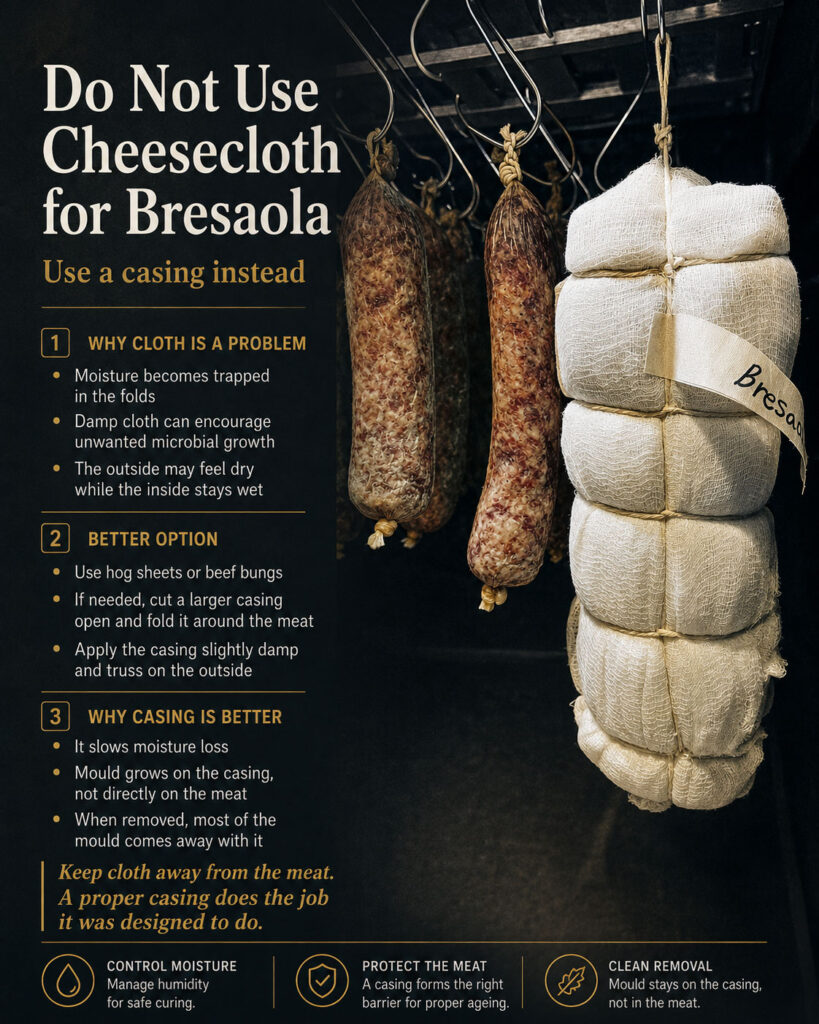
The Real Problem with Cheesecloth Is Moisture
During curing and ageing, meat loses water gradually. That moisture moves from inside the meat to the surface, and from the surface into the curing chamber. The process needs to happen slowly and evenly.
Cheesecloth changes the surface environment. It creates layers of absorbent fabric around the meat. Those layers can hold moisture in small folds, overlaps, and tied areas. This is especially problematic where the cloth is pressed tightly against the surface or trapped under string.
The outside of the cheesecloth may appear fine. It may even feel dry to the touch. But the inner folds can remain damp for much longer. That means the meat may be sitting against a wet textile layer while the person checking the cure thinks the surface is drying properly.
This is why cheesecloth is misleading. It gives the impression of breathability, but the important question is not only whether air can pass through it. The important question is whether the material holds moisture against the meat.
And cheesecloth can.
Damp Cloth Can Encourage Unwanted Microbial Growth
There are always microorganisms around cured meat. That is normal. Traditional curing is not a sterile process. Some surface flora may be expected, especially in curing chambers where mould develops on salami, ham, or whole-muscle cures.
The goal is not to remove every microbe from the environment. The goal is to control the conditions so the right processes are encouraged and the wrong ones are discouraged.
Moisture is one of the most important parts of that control. Water activity measures how much water is available for microorganisms to use. Lowering water activity through salting and drying is a major reason cured meats become more stable over time.
A damp cloth layer works against that principle. It can create a small wet micro-environment around the meat surface. In that environment, unwanted moulds, yeasts, or bacteria may have better conditions to grow.
This is especially concerning because the problem is partly hidden. Cheesecloth prevents you from seeing the meat surface clearly. You may not know what is happening underneath until the cloth is removed. By then, surface spoilage, unpleasant odours, slime, or problematic mould growth may already have developed.
Mould on Cured Meat Must Be Managed, Not Ignored
Mould is not automatically a disaster in cured meat production. Many traditional cured meats develop surface mould during ageing. In some cases, this is expected and even desirable.
But not all mould is safe or useful. Some moulds can produce mycotoxins under the right conditions. USDA food safety guidance notes that while moulds are common on some dry-cured hams, some moulds can produce mycotoxins.
That is why the location of mould matters.
When mould grows on a proper casing, it is growing on an outer protective layer. When the cure is finished, the casing can be removed, and much of the mould comes away with it. That is one of the practical advantages of using casing.
When mould grows directly on the meat, the situation is less controlled. It may be harder to clean. It may affect flavour, aroma, texture, or safety. It may also be more difficult to assess how deeply the problem has developed.
Cheesecloth does not solve this. It can make the situation worse by holding moisture and hiding surface conditions.
Why Proper Casing Is Better Than Cheesecloth
A casing is designed to work with the curing process. Cheesecloth is not.
For whole-muscle cured meats, a casing provides a controlled outer layer around the product. It helps moderate moisture loss, gives surface mould a better place to grow, and protects the meat underneath. For salami and other fermented sausages, the casing is already part of the structure of the product. It controls shape, surface drying, and maturation.
The casing does not simply “cover” the meat. It plays a functional role.
A good casing helps in three important ways.
First, it slows and regulates moisture loss. Drying too fast can create problems such as case hardening, where the outside dries too quickly and restricts moisture movement from the centre. Guidance for fermented sausage production recognises humidity control as important because poor humidity management can affect drying and product safety.
Second, casing creates a removable surface. Mould can grow on the casing rather than directly on the meat. That makes final cleaning and preparation easier.
Third, casing protects the product during maturation. It provides a better barrier than cloth while still allowing the meat to dry properly.
Which Cured Meats Does This Apply To?
The principle applies broadly to dry-cured meats that are hung, dried, matured, or aged.
This includes:
- Bresaola
- Coppa
- Lonzino
- Pancetta
- Guanciale
- Culatello
- Fiocco
- Dry-cured ham
- Whole-muscle venison or beef cures
- Dry-cured lamb or mutton cuts
- Salami and other dry-cured fermented sausages
The exact casing choice may differ depending on the product. A salami will usually be stuffed into a casing from the beginning. A whole-muscle cure may need to be wrapped in a casing after curing and before drying.
The basic rule remains the same: do not wrap the meat in cheesecloth as a substitute for casing.
What to Use Instead of Cheesecloth
For whole-muscle cured meats, use a suitable casing.
Common options include:
Hog sheets
These are useful for many whole-muscle cures. They can be wrapped around the meat and tied in place.
Beef bungs
These work well for larger cuts that need more coverage.
Large casings cut open
When a casing is not wide enough to pull over the meat, it can be cut open and folded around the product. It does not need to be stitched. The goal is to cover the meat surface with a functional casing layer.
Natural or collagen casings for sausages
For salami and other fermented sausages, the meat should be stuffed into an appropriate casing from the start. The casing choice should match the diameter, drying schedule, and intended product style.
The casing should generally be slightly damp when applied to a whole-muscle cure. This makes it more flexible and helps it sit neatly against the meat. Once the casing is in place, truss the product on the outside.
Why the Casing Should Go Under the Trussing
The order matters.
For whole-muscle cured meats, apply the casing first, then truss over it. This helps hold the casing tightly and evenly around the product.
If you truss the meat first and then try to cover it, the casing may not sit properly against the surface. It can bridge over tied areas, leave gaps, or create loose pockets. Those pockets can interfere with even drying.
A casing does not need to look perfect, but it does need to function properly. It should cover the meat, stay in place, and allow the product to dry in a controlled way.
Think of the casing as the working surface of the cure. The meat matures underneath it. The casing manages the outside.
Cheesecloth Looks Traditional, but That Does Not Make It Good Practice
Part of the appeal of cheesecloth is visual. It gives cured meat a rustic, old-world appearance. It looks handmade and traditional.
But curing is not about appearance first. It is about process control.
A material can look traditional and still create poor conditions. Cheesecloth can absorb moisture, hold it in folds, and hide what is happening on the surface of the meat. That is not helpful in a curing chamber.
Good curing practice is based on managing moisture, airflow, temperature, humidity, salt, time, and surface development. Guidance on fermented and dried meats consistently treats drying conditions, water activity, and process control as important for safety and quality.
A casing supports that process. Cheesecloth complicates it.
Common Mistake: “The Cheesecloth Feels Dry”
This is one of the most common reasons people continue using cloth.
They touch the outside and it feels dry. So they assume the meat is fine.
The problem is that the outside of the cloth is not the critical surface. The important area is the layer between the cloth and the meat. That layer may remain damp even when the outside feels dry.
This is especially true in folds, seams, overlaps, and areas under twine. Those small damp pockets can become active sites for microbial growth.
With casing, the surface is more controlled. With cloth, the surface is hidden and moisture can be trapped.
Conclusion: Keep Cloth Away from Cured Meat
Cheesecloth may seem harmless, but in dry curing it can create the wrong surface conditions. It can trap moisture, hide the meat surface, and encourage unwanted microbial growth in the folds of the fabric.
For cured meats, casing is the better tool. It slows and regulates moisture loss, gives mould a removable surface, protects the meat underneath, and supports more even maturation.
This applies beyond bresaola. It matters for coppa, pancetta, lonzino, guanciale, ham, salami, and other dry-cured meats.
Keep cloth away from the meat. Use a proper casing instead.
Food Safety Note
This article is for educational purposes and does not replace a validated curing process. Dry curing meat requires careful control of salt, cure, temperature, humidity, airflow, sanitation, time, and weight loss. If a cured meat develops unsafe mould, slime, unpleasant odour, unusual texture, or any sign of spoilage, do not consume it.
References
- Food Safety Authority of Ireland. Guidance Note 33: Good Manufacturing Practices for the Production of Ready-to-Eat Raw Fermented Meat Products.
- Meat & Livestock Australia. Guidelines for the Safe Manufacture of Smallgoods, 2nd Edition.
- BC Centre for Disease Control. Safety of Fermented Foods: Fermented Sausage Guidance.
- University of Minnesota Extension. Preserving Food at Home: Meat, Fish and Poultry.
- USDA Food Safety and Inspection Service. Molds on Food: Are They Dangerous?
- U.S. Food and Drug Administration. Mycotoxins.
- USDA Food Safety and Inspection Service. Overview of Ready-to-Eat Shelf-Stable Fermented, Salt-Cured, and Dried Products.