


Two pieces of meat. Same cut. Same animal. Same weight on the day they were prepared.
One has been in the fridge for six hours. The other has hung in a curing chamber for six months.
One cannot be eaten as it is. The other can.
Nothing has been cooked. No extraordinary chemistry has been applied. Salt. Time. A controlled environment. That is it.
So what changed between those two pieces of meat?
The answer is water activity. And once you understand it, the logic behind everything in dry curing begins to make sense.
Watch the Episode
Episode 3 of From Zero goes deeper into every part of this. The three types of water in meat, the full microbial threshold table, the steak demonstration, the 35% versus 38% debate, product-specific weight loss guides, and where water activity fits inside the Safety Triangle.
What Is Water Activity?
Water activity, written as aW, is a measurement of how available the water inside a food is to microbial life. It is not the same as moisture content, and that distinction matters enormously. We will get to it in a moment.
The scale runs from 0.00 to 1.00. Pure water, fully available, sits at 1.00. No available water at all would be 0.00, which is essentially impossible in real food. Fresh meat sits very close to the top of that scale, usually above 0.98. Most properly dried and cured products sit much lower.
The U.S. Food and Drug Administration defines water activity as the ratio between the vapour pressure of the food and the vapour pressure of pure water under identical conditions. That is the technical version.
The working version, which is the one that matters in a home curing environment, is this: water activity tells us how much usable water is available for microbial growth.
That is the question dry curing is designed to answer.
Water Activity Is Not the Same as Moisture Content
This is one of the most important distinctions in the whole subject, and it trips up a lot of people who are new to curing.
A product can contain a significant amount of water and still be resistant to spoilage. The reason is that water can be bound by salt, by sugar, by protein, and by other components in the food. When water is bound in this way, microbes cannot access it as easily.
Jam is the clearest everyday example. Jam contains a great deal of moisture. But much of that water is bound by sugar and pectin. The microbes cannot get to it in the same way they could get to the water in fresh fruit. That is why jam does not spoil quickly.
The same principle applies in cured meat. Salt does not only season. It changes the availability of water inside the muscle. That is what makes it a preservation tool rather than simply a flavouring.
So the question we ask in curing is not: how wet is this meat? It is: how available is the water inside this meat to the organisms that might want to use it?
The Three Types of Water in Meat
To understand water activity properly, it helps to know that not all the water in meat behaves the same way.
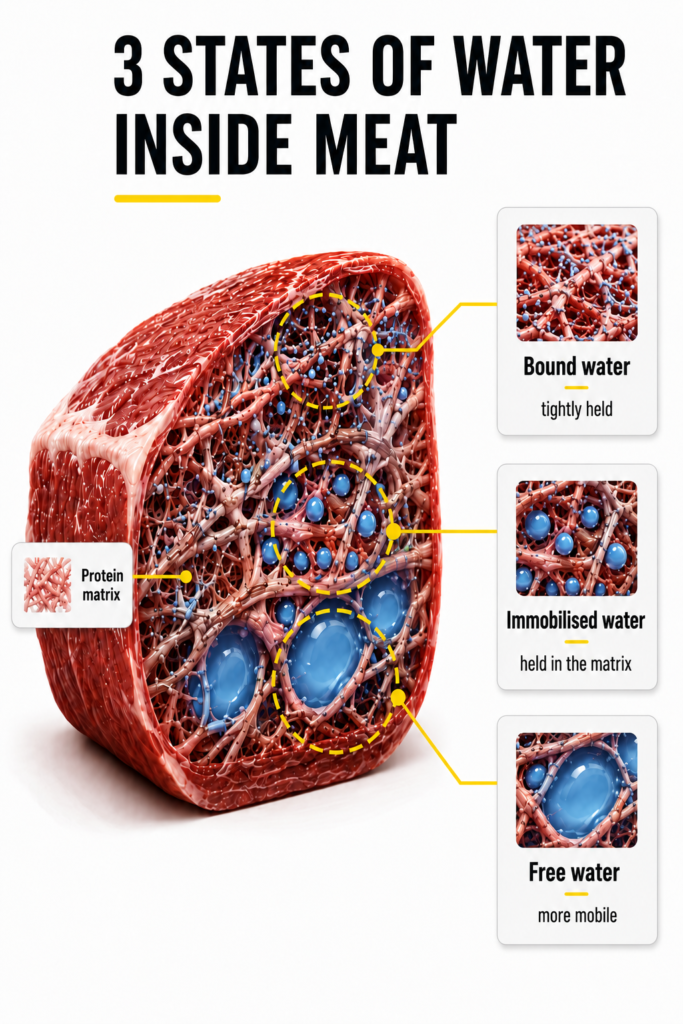
Lean muscle is roughly 75% water, but that water sits in three distinct states.
Bound water is held tightly by the muscle proteins. It takes extreme conditions to remove it, and in practical curing terms, it is not what we are working with. It is simply part of the structure.
Immobilised water is the largest proportion. It is held within the muscle structure and can move under the right conditions. This is the water that shifts gradually during a long, controlled cure. It needs time and the right environment to migrate from the centre of the meat to the surface, where it can evaporate slowly.
Free water is held loosely, by capillary forces. It moves easily. It is also the water most closely connected with microbial activity.
When we cure meat, we are not trying to remove all the water. We are trying to reduce the availability of a specific portion of it. That is the entire foundation of dry curing.
Why Microbes Care About Water Activity
Different microorganisms have different minimum water activity levels below which they cannot grow normally. This table shows some of the key ones:
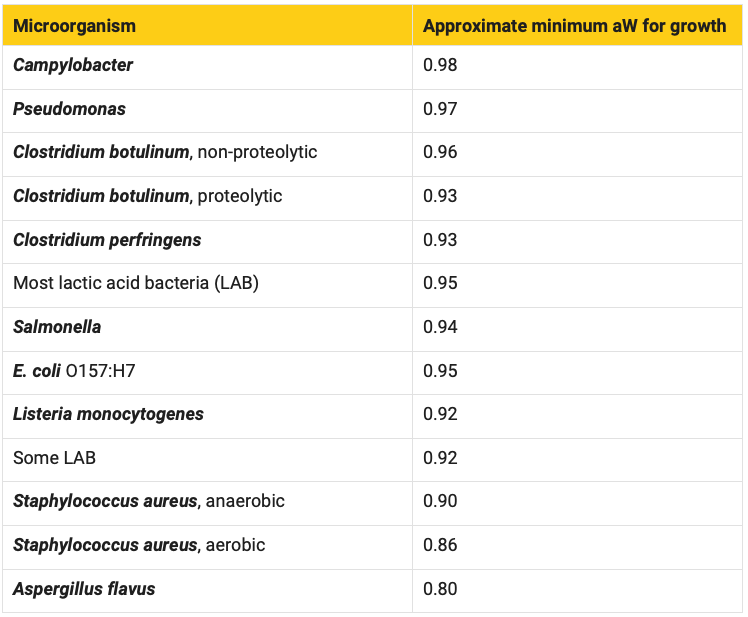
As the water activity drops, growth becomes progressively harder for each organism. By the time we approach 0.90 aW, most of the major meat-related pathogens are inhibited.
But here is the word to hold onto: inhibited, not destroyed. Lowering water activity does not sterilise meat. It does not make every microbial risk disappear. Some organisms can survive difficult conditions for a long time and become active again if conditions improve.
This is why Staphylococcus aureus gets particular attention. It tolerates a lower water activity than almost any other meat pathogen. If a cure is designed to deal with S. aureus, it is designed to deal with most of the others as well. Food safety guidance treats it as the benchmark organism for this reason.
And this is why water activity sits in the Roof of the Curesmiths Temple, at the top of the Safety Triangle. It is not one tool among several. It is the primary safety variable in dry curing, and everything else either supports it or depends on it.
How Do We Measure Water Activity at Home?
In a commercial setting, water activity can be measured directly with specialised equipment. Accurate. Reliable. Also expensive and unrealistic for most home curers.
In a home environment, we use weight loss as a practical proxy.
A proxy is not the same as a direct measurement, and being honest about that matters. Weight loss cannot prove that a product has reached a specific aW value. What it can do is track the drying process. Since most of the weight lost during dry curing is water, weight loss gives us a reasonable estimate of how far the product has moved from its fresh state toward a dried and more stable condition.
The calculation is straightforward. If a piece of meat weighs 1,000 g when you hang it, 35% weight loss means it needs to lose 350 g, bringing it to a target weight of 650 g.
That number on the scale is the working tool. But the curer needs to understand what it actually represents, and where its limits are.
Why Fat Distorts the Weight Loss Reading
Fat content is one of the biggest reasons weight loss must be interpreted carefully.
Lean muscle contains a lot of water. Fat contains very little by comparison. So when a product is very fatty, the total weight loss does not always tell us how much water has come out of the lean, water-bearing part of the meat.
Imagine a lean lonza and a fatty pancetta. Both lose 35% of their starting weight. Same number. Same percentage on the spreadsheet. But what has actually happened inside those two products is not the same.
The lonza is mostly lean muscle. Most of its weight loss reflects water leaving the meat.
The pancetta contains a much higher proportion of fat. The fat contributes weight but very little water. The lean parts are drying. The fat is mostly riding along.
The scale is honest about weight. It is not honest about water.
This is why the fattier the product, the more careful we need to be about treating total weight loss as a safety shortcut.
Weight Loss Targets: Why 38% Is a Better Working Number
35% weight loss is commonly cited as the minimum guide for whole-muscle dry cures. It appears in the charcuterie literature regularly, and it is not wrong exactly, but it sits at the lower edge of the safety envelope rather than in the middle of it.
In practice, 35% leaves less room for the natural variation that comes with different cuts, different fat contents, different chamber conditions, and different drying rates. 38% gives a more sensible working margin without pretending that weight loss is a perfect substitute for direct water activity measurement.
Different products call for different targets, and the right number depends on what is being made and how it will be eaten. A rough guide:
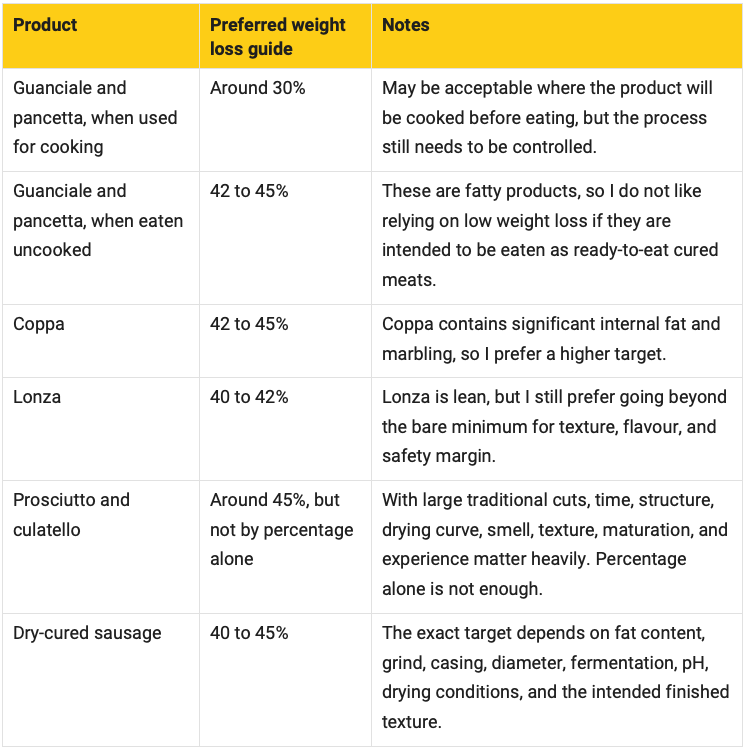
These are guides, not laws. As a product approaches its target range, weight loss is one signal among several. Texture, firmness, smell, surface condition, mould behaviour, and drying evenness all matter.
A product should never be harvested simply because the spreadsheet says it has reached a number.
Water Activity Does Not Fall on Its Own
There is one more piece to this.
Water activity is not something you set. It is something you earn, by controlling the environment around the meat. Moisture has to move from the centre of the product to the surface, where it can evaporate. That movement has to happen slowly and evenly.
If the surface dries too quickly, the outside hardens before the interior has had time to migrate moisture outward. The water gets trapped. The product can look finished on the outside while remaining unstable inside. That is case hardening, and it is one of the most damaging failures in home curing.
This is why Microclimate is the next corner of the Safety Triangle. Temperature, relative humidity, and air behaviour control whether the drying process happens properly. Water activity cannot fall safely without the right Microclimate around the product.
That is the subject of Episode 4.
Frequently Asked Questions
What is water activity in food?
Water activity (aW) is a measurement of how available the water inside a food is to microbial life, scored on a scale from 0.00 to 1.00. A value of 1.00 represents pure, fully available water. As the value drops, less water is accessible to microbes. Fresh meat typically sits above 0.98. Properly dried cured meats sit much lower.
What is the difference between water activity and moisture content?
Moisture content tells you how much water a food contains. Water activity tells you how available that water is to microbes. A food can contain moisture and still resist spoilage if that water is bound by salt, sugar, or protein. Jam contains significant moisture but resists spoilage because much of its water is bound by sugar and pectin. Cured meat works on the same principle.
What water activity level stops bacterial growth?
Different organisms have different thresholds. Most major meat-related pathogens are inhibited below approximately 0.90 to 0.93 aW. Staphylococcus aureus, which tolerates lower water activity than most, can still grow aerobically at 0.86 aW. Lowering water activity does not destroy microbes, it inhibits them. A safe cured product depends on water activity working alongside salt, pH, temperature, hygiene, and time.
How do I measure water activity at home?
Most home curers cannot measure water activity directly, as the equipment is expensive. Weight loss is the standard practical proxy. Since most of the weight lost during dry curing is water, tracking weight loss gives a reasonable indication of how far the product has moved toward a stable, dried condition. A general working target for many whole-muscle dry cures is 38% weight loss, though the right target depends on the product, its fat content, and how it will be eaten.
Is 35% weight loss enough for dry-cured meat?
35% is the figure commonly cited in charcuterie literature as a minimum guide. It is not wrong, but it sits at the lower edge of the safety envelope rather than in the middle of it. A general working target of 38% gives a more sensible margin, accounting for the natural variation in different cuts, fat contents, and chamber conditions. For fatty products intended to be eaten uncooked, higher targets of 42 to 45% are more appropriate.
Go Further
Every week, the Curesmith newsletter covers one substantive idea from more than twenty years of curing practice. Sometimes it is a deeper exploration of a corner of the Safety Triangle. Sometimes it is a diagnostic question, a case study from the chamber, or a closer look at one of the Temple Pillars.
If that sounds useful, sign up right here!
YouTube Video References
Primary Sources for This Episode
U.S. Food and Drug Administration. Water Activity (aw) in Foods. Inspection Technical Guide No. 39, 1984.
University of Wisconsin–Madison, Centre for Meat Process Validation. Principles of Preservation of Shelf-Stable Dried Meat Products, 2005.
Getty, K. and Gaikwad, R. Water Activity of Foods. K-State Research and Extension, Publication MF3674, September 2024.
Borneman, D. L., Ingham, S. C., and Ané, C. Predicting Growth-No Growth of Staphylococcus aureus on Vacuum-Packaged Ready-to-Eat Meats. Journal of Food Protection, Vol. 72, No. 3, 2009, pp. 539-548.
U.S. Food and Drug Administration. Bad Bug Book: Foodborne Pathogenic Microorganisms and Natural Toxins Handbook (2nd Edition). 2012.
Marianski, S. and Marianski, A. Home Production of Quality Meats and Sausages. Bookmagic, LLC, 2010.
Ferreira, G. Airflow in Home-Sized Meat Curing Chambers; The Curesmith, May 2026