



Want more recipes like this?
Drop your email and we’ll send you new recipes, guides and tips as we add them. No spam — ever.
✓ You’re in! Continuing now…
Gil’s Goan Dry-Cured Chorizo
A Goan-Portuguese fusion of Indian spice and traditional dry-cured sausage — with ginger, kashmiri chilli, feni and lemon. Usually semi-dried, this recipe can be taken to 30% weight loss to use in cooking, or to 40% to eat as is.
New to fermented sausages, or want step-by-step guidance?
The Recipe Wizard walks you through this recipe one step at a time, with explanations at every stage.
Ingredients
g
Adjust to scale
the recipe
the recipe
We default to 1000g pork as the base weight. All ingredient ratios are easy to read at a glance. Change the weight above to scale the recipe automatically.
| Meat & fat | ||
| Pork shoulder | 100% | 1000 g |
| Pork back fat | 20% of total mix | 200 g |
| Total mix | 1200 g | |
| Cure & salt | ||
| Sea salt (additional) | 2.0% of total mix | 21.2 g |
| Cure #2 is approximately 94% sodium chloride. This additional sea salt, combined with the salt already in the cure, brings the total to your 2.0% of total mix target. | ||
| Cure #2 | for 156 ppm | 2.95 g |
| Fermentation sugar | ||
| Dextrose | 1.0% of total mix | 12.0 g |
| Dextrose is preferred for fermented sausages as it is more predictable with starter cultures. If substituting sugar, use 60% of the dextrose weight: 7.2 g | ||
| Spice blend | ||
| Kashmiri chilli (or Ancho) | 1.83% of total mix | 22.0 g |
| Kashmiri chilli gives a deep brick-red colour and mild, earthy heat. Ancho is a suitable substitute with a slightly fruitier, smoky character. Do not substitute with generic chilli powder as the heat level and flavour profile will differ significantly. | ||
| Black pepper, ground | 0.33% of total mix | 4.0 g |
| Fresh ginger, grated | 2.17% of total mix | 26.0 g |
| Peel and finely grate the ginger before weighing. Fresh ginger is essential to this recipe — do not substitute with dried or powdered ginger as the flavour character is fundamentally different. | ||
| Garlic powder | 1.0% of total mix | 12.0 g |
| Cumin seeds, toasted | 0.17% of total mix | 2.0 g |
| Turmeric | 0.17% of total mix | 2.0 g |
| Ground cloves | 0.33% of total mix | 4.0 g |
| Cloves are extremely pungent. Weigh carefully and do not increase this amount — even a small excess will overpower the other spices. | ||
| Liquids | ||
| Lemon juice, fresh | 3.83% of total mix | 46.0 g |
| Goan vinegar (or red wine vinegar) | 5.0% of total mix | 60.0 g |
| Feni (or vodka) | 2.5% of total mix | 30.0 g |
| All liquids must be weighed in grams — do not measure by volume. Chill all liquids to below 4°C before use and add to the farce last, after all other ingredients are fully incorporated. Goan vinegar (caju vinegar) is the traditional souring agent for this sausage and gives it its characteristic tang. Red wine vinegar is a readily available substitute with a similar acidity. Feni is a Goan cashew spirit that adds a distinctive aromatic depth. Vodka is a neutral alternative. | ||
| Starter culture | ||
| Flora Italia LC | 0.13g per kg | 0.13 g |
| Distilled water (to dissolve culture) | 20g per kg | 20 g |
| Flora Italia LC dose: 0.13g per kg of pork. If you do not have a precision scale, use 1g — you cannot meaningfully overdose a starter culture. Dissolve in the distilled water shown above before adding to the meat. T-SPX is a suitable alternative if Flora Italia LC is unavailable. |
||
Nitrite safety check
Nitrite (NO₂)
156.0ppm
Nitrate (NO₃)
99.8ppm
Nitrite level156.0 / 200 ppm max
0156 ppm200 ppm
Safe
Within safe limits. Effective for pathogen control throughout the full drying and ageing period.
Important: weight loss targets
Gil’s Goan Dry-Cured Chorizo can be taken to 30% weight loss for use in cooking (stews, rice dishes, curries), or to 40% weight loss to eat as is. If eating uncooked, do not consume before confirming 40% weight loss by weighing.
Method
1
Chill everything thoroughly. Place the pork shoulder and back fat in the freezer for 30 minutes before grinding. Cold meat and fat are essential for a clean grind and good bind.
2
Grind the meat and fat. Pass both the pork shoulder and back fat together through a 6mm plate. Keep refrigerated between steps.
3
Prepare the spice blend. Combine the sea salt, dextrose, kashmiri chilli, black pepper, grated ginger, garlic powder, toasted cumin seeds, turmeric and ground cloves. Mix thoroughly to ensure even distribution before adding to the meat — do not add the ingredients individually. Hold off on adding the Cure #2 (or Salvianda) if you are going to do a taste test as described in step 5a below.
4
Dissolve the starter culture. Mix the Flora Italia LC into cold distilled water and set aside. This ensures even distribution throughout the farce.
5
Mix the farce. Combine the ground pork and fat with the spice blend. Add the Cure #2 (or Salvianda) (only if you are not doing a taste test — see step 5a below) and work it in until evenly seasoned and slightly tacky. Add the dissolved culture (only if not doing a taste test — see step 5a below) and mix through. Finally add the chilled lemon juice, Goan vinegar and feni in that order, mixing until just incorporated after each addition. To test that sufficient myosin extraction has taken place, roll a small amount of farce into a ball and press it firmly to your palm. Turn your palm face down — the farce should cling without falling for at least 20 seconds. This confirms proper protein extraction, which ensures the finished sausage will be firm and hold together cleanly when the target weight loss is reached. If it falls, continue mixing and test again.
5a
Taste test (recommended). Do this before stuffing and before adding the Cure #2 (or Salvianda) and starter culture. Take a golf ball-sized sample of the seasoned farce and poach it gently in hot water until cooked through. Allow to cool completely, then taste. This gives you a clear picture of the flavour profile before committing to the full drying process. Adjust your seasoning if needed. Once you are satisfied, add the Cure #2 (or Salvianda) and starter culture to the remaining farce and mix thoroughly for at least another minute before stuffing.
6
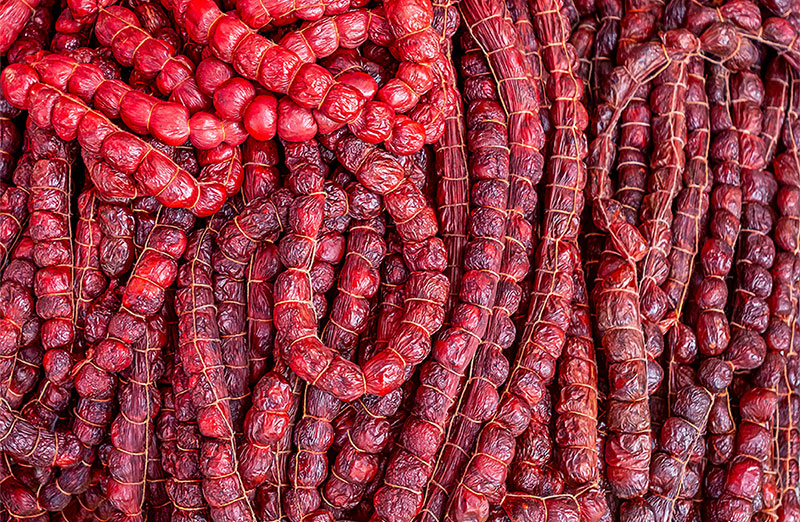
Stuff and coil the casings. Stuff into hog casings (32–38mm) firmly as one continuous length, avoiding air pockets. Coil the stuffed sausage into a flat spiral. Using natural twine, tie across the coil at regular intervals to bind the loops together and hold the shape. This is the traditional Goan presentation — the flat coil sits evenly in the drying chamber and allows for easy portioning when cooking. See the feature image of this recipe for how the sausage is tied. Prick any visible air pockets with a sterile pin.
7
Apply surface mold (optional but recommended). Immediately after stuffing, mist or dip the casings with a diluted Mold 600 (Penicillium nalgiovense) solution, prepared per the manufacturer’s instructions. Surface mold regulates moisture loss and contributes to complex flavour development during the drying period.
8
Fermentation phase. Hang at 22–26°C and 85–90% relative humidity for 12–24 hours. Monitor with a calibrated pH meter and transfer to the drying chamber once pH 5.3 is confirmed. Do not rely on colour strips.
9
Drying phase. Transfer to a drying chamber at 12–14°C and 73–75% relative humidity. Hang the coils or lay them flat on a rack in the drying chamber. Ensure they do not touch each other. The higher liquid content of this recipe means moisture loss in the early drying stages will be more pronounced — begin checking weight loss from week 2.
10
Monitor weight loss. Weigh the chorizo weekly from the start of drying. Record the pre-drying (green) weight so you can track percentage loss accurately. Take it to 30% weight loss to use in cooking, or continue to 40% to eat as is. We provide a Production Log in the downloadable Excel file to help you track weight loss accurately.
Key tips
Keep everything cold throughout, including all liquids. Grate the ginger finely and weigh it after peeling. Add the lemon juice, Goan vinegar and feni last and separately, mixing after each. The higher liquid content makes this farce wetter than a standard chorizo — this is normal and will resolve during fermentation and drying. Coil into a flat spiral and tie across with natural twine at regular intervals — see the feature image for reference. Apply Mold 600 immediately after stuffing.
Drying parameters
Fermentation12–24 hrs • 22–26°C • 85–90% RH
Drying temperature12–14°C
Humidity73–75% RH
FormFlat coil (traditional Goan)
Drying time4–6 weeks
For cooking30% weight loss
To eat as is40% weight loss